
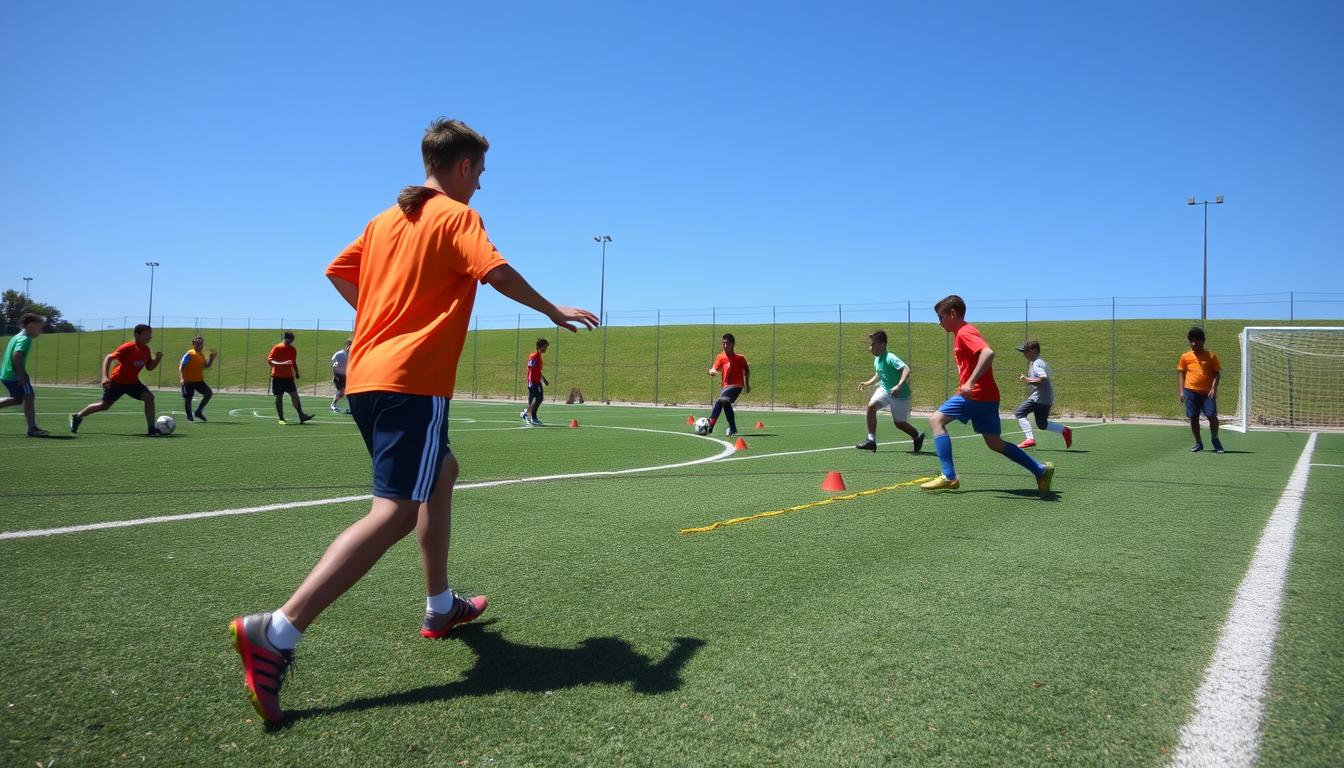
Did you know practicing soccer just two to three times a week helps a lot? Spending 30 to 45 minutes each session can improve your skills fast. Every three to four weeks, you might see better ball control, speed, and accuracy. It shows that regular training and the right drills are key for all players.
Effective soccer drills are the core of developing essential skills. These include dribbling, passing, shooting, and staying fit. By working on these drills, players boost their game and get ready for competition.
Every drill, from juggling for better ball control to wall exercises for passing, is important. This training builds agility and quick response on the field. It helps athletes shine in games and in their soccer careers.
Key Takeaways
- Consistency in soccer drills vastly improves skills across various aspects of the game.
- A variety of soccer training exercises enhances agility, endurance, and ball control.
- Engaging in targeted drills helps in developing precise shooting and passing abilities.
- Incorporating fun drills can maintain player engagement while improving fundamental skills.
- Regular practice is essential for long-term skill development and match preparedness.
The Importance of Practicing Soccer Drills
Practicing soccer drills is very important in a player’s development. These drills improve techniques, teamwork, and confidence on the soccer field. Basic skills like ball control and accurate passing create a solid base for playing well. Regular practice turns beginners into skilled players.
Building Fundamental Skills
Players get better by repeating drills and practicing a lot. Doing drills like dribbling and passing helps players touch the ball more. Instead of touching the ball 30 to 50 times in a game, they can get over 1,000 touches in just 10 minutes of practice. This helps players improve quickly.
Enhancing Teamwork
Drills that need teamwork help build a sense of unity. They also let players practice game-like situations together, strengthening their teamwork. This preparation is key for real games and helps in strategizing as a team.
Boosting Confidence
Consistent drill practice raises a player’s confidence. As players get better, they feel more ready for games. 89% of Soccer Coach Weekly subscribers said drills made them more confident. Mixing personal and team practice helps players grow individually and as part of a team.
| Benefit | Impact of Soccer Drills |
|---|---|
| Fundamental Skills | Improved ball control and passing accuracy lead to better overall performance. |
| Teamwork | Drills promote collaboration and strategic understanding among players. |
| Confidence | Skill mastery leads to increased self-assurance on the pitch. |
| Mental Acuity | Decision-making and cognitive skills see significant improvement through practice. |
| Repetitive Practice | Regular drills ensure skill refinement and readiness for game time. |
Dribbling Drills for All Levels
Dribbling is key in soccer, letting players move past defenders and keep the ball. Drills improve technique and awareness. Two drills stand out: the Cone Dribbling Drill and the 1v1 Dribbling Challenge.
Cone Dribbling Drill
This drill boosts agility and ball control. Players navigate cones in patterns, keeping tight control of the ball. It teaches quick moves, considering both speed and precision. Changing patterns and speeds makes practice fun and tough.
1v1 Dribbling Challenge
The 1v1 Challenge mimics game pressure, with players keeping the ball against a defender. It pits two players in attack and defense roles. The attacker aims to pass the defender and score. It sharpens footwork and boosts game-time decisions.
Using these drills in training helps players get better at dribbling. They become more confident and skilled on the field.
Passing Drills to Improve Accuracy
Passing drills are key for soccer players to get better. These drills help with teamwork, talking on the field, and making quick decisions. Regular practice lets players sharpen their passing skills. This boosts their play quality. Here are some drills that focus on making passing more accurate.
Wall Pass Drill
The Wall Pass Drill involves hitting the ball against a wall. It’s great for working on how you first touch and catch the ball. By aiming for a certain spot on the wall, players get better at passing. Trying this from different spots and distances makes the drill fit for all levels.
Triangle Passing Exercise
Three players pass the ball in a triangle shape in this drill. It helps them know where they are on the field and pass well even when it’s tough. They need to speak well and keep passes sharp and fast. Doing this thing helps players get better at passing in real games.
One-Touch Passing Drill
This drill is about moving the ball quickly with just one touch. It’s key for tight spots in games. It makes players faster thinkers and better at passing with precision. It also gets them used to using both their feet. This drill is a big help in improving passing skill on the field.
| Drill Name | Focus Area | Player Benefits |
|---|---|---|
| Wall Pass Drill | First touch, accuracy | Improved quick passing and control |
| Triangle Passing Exercise | Spatial awareness, teamwork | Enhanced communication and precision |
| One-Touch Passing Drill | Speed, decision-making | Better performance under pressure |
Adding drills like the Wall Pass, Triangle Passing, and One-Touch Passing to practice sessions is very helpful. They make players much better at passing accurately. With ongoing practice, these methods greatly improve soccer skills and team play on the field.
Shooting Drills to Score More Goals
Shooting is a key skill for soccer players looking to get better. Focusing on specific shooting drills can improve goal-scoring skills a lot. Drills help players shoot more accurately and play confidently. Here are three drills that help players score more goals and shoot better.
Target Practice Drill
This drill has players start in two lines, 25 yards from the goal. They dribble to the penalty spot and shoot. The aim is to hit certain spots in the goal, which helps with accuracy. The better a player gets at hitting these spots, the more likely they are to score in games.
Penalty Kick Simulation
It’s important for players to practice high-pressure situations. This drill simulates penalty kicks to help players get used to game pressure. It improves shooting accuracy and helps players stay calm during important shots. Players get better at making crucial shots by practicing in these conditions.
Shooting Under Pressure Drill
Players face defenders in this drill to get better at shooting under pressure. Attackers work to get past defenders and shoot. The drill works on shooting accurately while playing against defense. Players learn to keep focused and score even when under pressure.
| Drill Name | Description | Benefits |
|---|---|---|
| Target Practice Drill | Players aim for specific areas in the goal from 25 yards. | Improves shooting precision and accuracy. |
| Penalty Kick Simulation | Simulates high-pressure penalty shots. | Builds composure and accuracy under stress. |
| Shooting Under Pressure Drill | Players practice shooting while facing defenders. | Enhances shot accuracy and decision-making in real-game scenarios. |
Practicing these drills regularly can significantly enhance a player’s scoring ability. This leads to better performance on the field.
Defensive Drills to Strengthen Backline
Defensive drills are key in soccer. They boost the backline and up players’ defense game. Jockeying Technique Drill and 1v1 Defending Exercise are vital. They boost individual skills and improve team communication and unity.
Jockeying Technique Drill
The Jockeying Technique Drill teaches positioning. It’s about standing between the opponent and the goal. The drill builds patience, steering attackers to less risky field areas. It focuses on:
- Strategic movement emphasis
- Delaying attackers better
- Boosting defensive awareness
1v1 Defending Exercise
The 1v1 Defending focuses on tackling and positioning. Players learn to defend against attackers one-on-one. Perfecting this is crucial for stopping forwards. This exercise enhances:
- Defensive skills on an individual level
- Decision-making when pressured
- Confidence in defensive prowess
Defensive Drills for Soccer in training aims at a stronger backline and better teamwork. They lay a base for defensive skill improvement across different game situations.
| Drill Type | Focus Area | Duration (minutes) | Team Configuration |
|---|---|---|---|
| Jockeying Technique | Positioning and Movement | 3 | 6 attackers, 4 defenders |
| 1v1 Defending | Tackling Skills | 3 | 6 attackers, 5 defenders |
Goalkeeper Drills for Better Saves
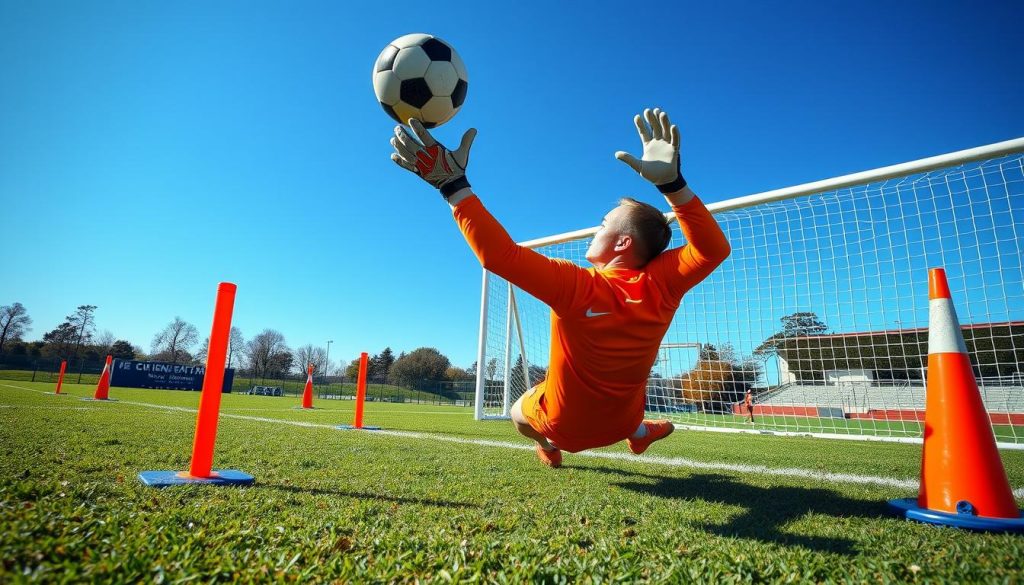
Being a great goalkeeper means practicing hard. It’s all about honing skills with specific drills. These drills boost quickness, agility, and how well you can see and catch the ball. We’ll look at key exercises that make goalkeepers better. They also help understand game plays better.
Reaction Time Drill
This drill teaches goalkeepers to react fast to shots from different directions. It helps sharpen your reflexes. This means you can decide in a flash during games. Mastering this is key for making those game-saving catches.
Distribution Drill
Good play distribution kicks off attacks or gets the game going again. This drill lets goalkeepers practice sending the ball accurately to team members. It’s great for playing well under pressure. It makes sure the game flows smoothly.
Angle Play Drill
Knowing about angles is super important for goalkeepers. The Angle Play Drill puts you in various scenarios attackers might use. It improves how you make decisions. This is about guessing where the shooter will aim and being in the right spot. Being good at this makes a goalkeeper really effective in games.
Fun Soccer Drills for Kids
Kids develop important skills while having fun with soccer drills. Youth Soccer Drills create excitement and encourage friendly competition. They help players stay motivated. Some drills show how fun can help with learning skills.
Red Light, Green Light
This classic game makes dribbling practice fun. It teaches kids to control the ball and react quickly. When “green light” is called, players dribble forward. They must stop quickly on “red light”. This improves their stopping and starting skills, which are vital for soccer.
Dribble Knockout
This game is all about keeping your ball safe while trying to knock others’ out of the area. It’s designed to be exciting and competitive. By dodging and tackling, players get better at controlling their soccer balls. It’s a fun way to learn teamwork and think fast during play.
Conditioning Drills to Enhance Endurance
Conditioning drills help soccer players get better at agility, speed, and endurance. These exercises boost cardio fitness and get athletes ready for demanding soccer matches. By doing various drills, players can see big improvements and face the physical challenges of the game.
Shuttle Runs
Shuttle runs are crucial for improving endurance. They mimic the movements of a game, where players run between cones. Doing five reps, or 500 yards in total, builds cardiovascular stamina and quick acceleration. This lets players keep up their energy throughout the game.
Agility Ladder Drills
Agility training is key for quick direction changes needed in soccer. Agility ladder drills improve foot speed and coordination, which helps in dodging defenders and reacting swiftly. Varying patterns in the ladder drill boost quickness and ball handling efficiency. This makes players more effective in key moments of the game.
| Drill Name | Focus Area | Distance/Duration |
|---|---|---|
| Shuttle Runs | Endurance, Acceleration | 5 reps, 500 yards total |
| Agility Ladder | Foot speed, Coordination | Variable patterns |
| Pain Shuttles | Speed, Agility | 200 yards per rep, rest 30 seconds |
| On-ball Off-ball Running | Speed, Direction change | Grids of 13×13 yards |
| Torture Run | Endurance, Stamina | Minimum 6 laps |
By doing soccer conditioning drills regularly, players can boost their performance. This helps them outperform opponents and shine in stressful situations. A strong endurance base lets soccer players greatly improve their game.
Small-Sided Games for Realistic Practice
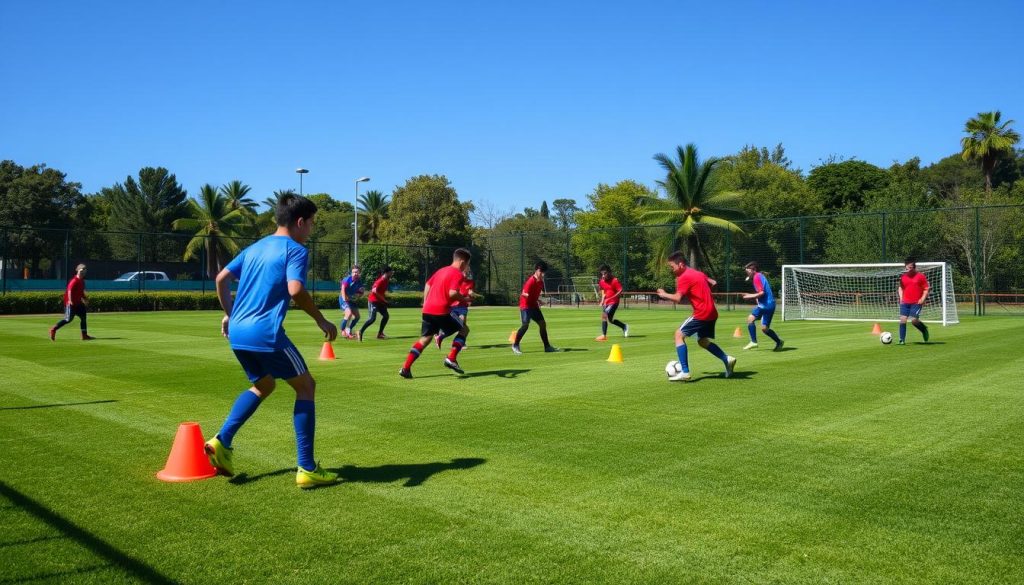
Small-sided games like 3v3 and 5v5 are great for soccer practice. They create realistic practice scenarios that help players learn and grow. Players get to work on teamwork and improve their skills in these games.
3v3 Match
The 3v3 match is fast and fun. It lets players get a lot of touches on the ball. They can work on dribbling, passing, and shooting in a small area. Every player gets a chance to stand out, making teamwork important.
5v5 Scrimmage
The 5v5 scrimmage gives a bit more room to play and adds strategy. It improves team communication and working together. Players practice switching from attacking to defending, which mimics real games. This helps them get better at using game strategies.
| Game Format | Key Benefits | Focus Areas |
|---|---|---|
| 3v3 Match | Maximizes player contact with the ball | Dribbling, quick decision-making |
| 5v5 Scrimmage | Enhances tactical awareness and teamwork | Passing, positioning, communication |
Using small-sided games for soccer in training helps coaches teach many skills. These games work for all age groups, from young kids to adults. Everyone enjoys them, and they make training more effective.
Incorporating Technology in Soccer Training
Technology is changing the way soccer players train and improve. It lets them sharpen their abilities and see their growth clearly. Tools like Video Analysis for Soccer and Soccer Training Apps are crucial to these changes.
Video Analysis for Skill Improvement
Video Analysis for Soccer marks a big step in training. Players can look back on their play and tweak their actions. Companies like TOCA Football provide instant feedback with real-time data. This improves players’ game understanding and decision-making.
- The Touch Trainer offers more than 200 real-game touches per session, helping skills get better.
- Smart Targets create real-game scenarios, boosting players’ quick thinking and choices.
- Studio screens show how well players are doing, encouraging ongoing progress.
Soccer Apps for Tracking Progress
Soccer Training Apps, such as Anytime Soccer Training, give access to over 1,000 training videos and games. Players can practice on their own, easing the load on parents and teaching kids responsibility. Coaches can tailor training by setting specific challenges and video tasks.
- With over 101 fun soccer games, the platform adds competition to skill building.
- Being able to train anytime and anywhere with different gadgets means no missed practice opportunities.
- This program boosts the amount of personal practice, enhancing abilities and confidence.
The Role of Coaches in Implementing Drills
Coaches are crucial in soccer training. They shape the practice techniques and the guiding philosophy for developing players. Strong coaching strategies help boost both individual and team skills.
Effective Coaching Strategies
Good coaching tactics need proper planning and action. Coaches often run training sessions twice a week. They must keep these organized. This avoids wasted time and keeps players attentive and involved. Every session has clear goals like improving defensive play or ball handling.
- Each drill should reflect the club’s playing philosophy for coherence across age levels.
- Monitoring and evaluation of training effectiveness is key for ongoing improvement.
- Regular meetings with fellow coaches foster collaboration and the sharing of insights regarding drill effectiveness.
Encouraging Player Development
Player growth relies on mixing traditional drills and game-like practices. Beginners get a lot from standard drills. These drills let them repeat movements to better their skills. But, game-based methods keep practice related to actual play. Players learn to use their skills in real situations. This builds quick thinking and creativity under pressure.
| Method | Benefits | Challenges |
|---|---|---|
| Traditional Drilled Practice | Suitable for basics; builds muscle memory | Can be monotonous; less engagement |
| Game-Based Practice | Realistic scenarios; encourages creativity | Less “on the ball” time; focus may shift to winning |
Mixing both training methods can lead to great coaching in soccer. It promotes solid player development. Adjusting drills to match different player needs can create impressive outcomes.
Building a Routine for Soccer Practice
Making a regular routine for soccer practice is key to getting better and having fun. By having clear goals for each session, players can work on areas like dribbling or shooting. This helps them improve in specific ways. It also lets athletes see their progress, which makes them feel good and love the sport even more.
Setting Goals for Each Training Session
Having clear goals in training keeps everyone on track and excited. Coaches should help players pick goals that match their skills and dreams. This method makes athletes want to get better and change as needed. It makes practicing more meaningful. Plus, using the Four Corner Model helps players grow in all parts of the game.
Keeping Sessions Engaging and Fun
It’s important to make soccer practice fun to keep youths interested. Mixing different drills keeps everyone moving and happy to join in. Starting with welcoming activities and using game-like drills keeps players focused and happy. By blending skills work with fun, practice makes players love and stick with soccer.